Ambleside Schools International Articles
Browse more Ambleside Schools International Resources.
All Flourishing is Mutual
At our campus in Fredericksburg, TX, the coming of fall is announced with a “thud.” As the winds change and the grass all around us dies off, a special gift begins to fall from the trees in the grove where our students play: pecans. As soon as the pecans hit the ground, our students get busy as squirrels making stockpiles of nuts. They divide into groups and let their imaginations soar. You can find pecans hoarded behind trees, hidden under rocks, spilling out of pants pockets, and sometimes left forgotten and rotting in the bottom of backpacks. The sudden excess of pecans turns them into a trading commodity or currency for purchasing other make-believe items. Students come to me complaining that their “store that charges 4 pecans for each sparkly pebble” simply cannot keep up with the prices of the “store that only charges 1 pecan per pebble.” Frustrated students complain: “They are stealing all of our business!” In the space of a few hours or days, this gift quickly becomes yet another object to fight over. Students compete to see who can gather the most pecans, transforming these sweet nuts into a status symbol.
Shortly before our pecans started falling this year, Leslie Voorhees paid our campus a visit. As we were enjoying some time together after school, she began sharing about Bethel Academy, the Ambleside School in Nigeria. She spoke of the bravery of Brother Israel, the school’s principal and founder – how he had made a leap of faith to move his family from their comfortable home in Lagos to rural Ogun State. She remarked on the difficulties he had overcome to transition his entire program to become an ASI member school. She spoke of the dangers they faced as the Nigerian government became increasingly unstable, as travel in and out of Nigeria became more complicated, and as the ongoing persecution of Christians was on the rise. She knew that they needed new books (many of the books they purchased when they became an ASI member school are already tattered and worn) and a new school bus (They lost about 30 students this year due to an ongoing issue with public transportation). As Leslie spoke of these needs, I felt a draw towards Brother Israel and Bethel Academy. I wanted to know more about this courageous man of faith. His school’s needs felt attainable – the impact of meeting these needs felt momentous: a bus would mean a quality education for 30 students and new books could guarantee the ongoing success of this program for many more years to come. I thought of the number of books we purchase in a single school year simply to make sure we have the most updated editions; and not because the books were falling apart in our students’ hands.
So I sent an email to Brother Israel. In our brief interactions back and forth, I have been moved by his faith, humility, and love for others. After some earnest research, Brother Israel was able to share that a new bus for their community will cost $7,500-$8,000. While this may sound like a small sum to American readers, it is a large sum of money in a country where the median household income is about $2,800/year. While Bethel Academy has been blessed with a small business where they bag rice for local farmers, this business mainly helps to break the difference between what families are able to pay in tuition and the actual cost of keeping the school up and running.
Which brings us back to pecans. As I studied pecans more this year to prepare a round of Nature Study lessons for my staff, I was moved by the shocking world of pecans that Robin Kimmerer cracks open in her book, Braiding Sweetgrass: Indigenous Wisdom, Scientific Knowledge, and the Teaching of Plants. Pecans, or pigans, as her indigenous ancestors called them, are the result of a process known as mast-fruiting. Some fruit trees bear fruit every year dependably at around about the same time in around about the same predictable amounts. Pecan trees are not predictable: “Mast-fruiting trees spend years making sugar, and rather than spending it little by little, they bank calories like starch in their roots.” Pecans wait till they have a surplus of starch before they fruit; but starch isn’t the only thing they wait for:
“If one tree fruits, they all fruit – there are no soloists. Not one in a tree grove, but the whole grove; not one in the forest, but every grove; all across the country and all across the state. These trees act not as individuals, but as a collective. Exactly how they do this, we don’t yet know. But what we see is the power of unity. What happens to one happens to us all. We can starve together or feast together. All flourishing is mutual.”
All flourishing is mutual. These words bounced around in my head as I read them. The Council of Pecans, as Kimmerer calls the mysterious communication network that unites these trees, had blessed us with an abundant harvest. Instead of allowing these pecans to become a source of spiritual starvation and derision, I wondered if our abundance of pecans could be translated into another form of abundance for yet another community. Perhaps our little pecan harvest could provide a bus for Bethel Academy: all flourishing is mutual.
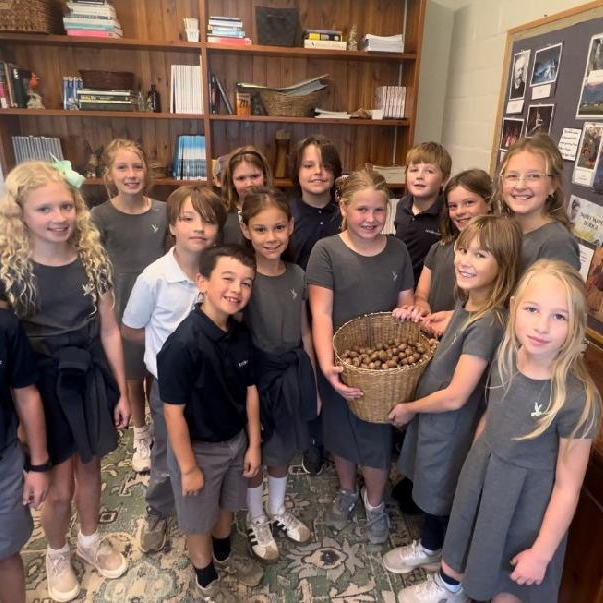
And so it began. We told students about our Sister School in Nigeria. We came up with the idea of collecting nuts to shell, cook, and sell as treats at an upcoming school event. Fairly suddenly, these little pecans that had divided students began to unite them. They began collecting their stashes and moving them into a shared bucket outside of my office. Students could be seen before school and during their breaks gathering, shelling, and hulling pecans. A seed of generosity and kindness was growing as students shifted their attention away from themselves towards helping others. Children would stop by my office to look at the pictures I have of Bethel Academy and to ask about their students. At the end of every break, there would be a line of students emptying out their pants pockets and carrying in tied-up sweaters full of nuts. One first grader even paused as she was emptying all of the pockets in her pants and sweater to say, “I only eat one pecan a day now; the rest I collect are for the children in Nigeria.” Our students now ask to pray for our Sister School and love receiving any updates we can provide about their community. We held our first sale at our annual Grandparent’s day event and made $1,009. Our goal was to make $1,000. We felt God’s provision and affirmation of our project in that extra $9.
Tired of cracking nuts, we shifted our energy after Thanksgiving towards making Christmas ornaments. During the Advent Season, we have a tradition on our campus of allowing students to work on making handmade Christmas ornaments during Read Aloud and quiet times. Normally, students put their first ornament on our campus Christmas tree and keep the rest for themselves, or to give as gifts to family. This year, we offered that students could also opt to give their ornaments for a Christmas craft sale that would benefit Bethel Academy. We ended up with a tree covered limb to limb with ornaments, and we had to add an extra display table to hold all of the ornaments that students wanted to donate. At this second sale at our Christmas Candlelight Service, we made about $500.
We are still about $6,000 away from our final goal, but I believe that God will provide. I put a laminated sign outside my office for students to provide more fundraising ideas and will work with individual classes to make these ideas a reality. Some students have even discussed organizing their own personal lemonade sales and bringing back the proceeds to donate to Bethel Academy. I’ve asked Brother Israel to share his prayer intentions with us as well as news about his school community so that our students are building a real and lasting relationship with the students at Bethel Academy. I’m also taking time to educate myself and our students on Nigerian geography, ecology and culture.
We believe that we will achieve our goal faster with more help. If your school is interested in partnering with us – if you would like to take some element in which you are flourishing and bless another community – please join us in our effort to continue providing for Bethel Academy’s needs.
Earlier this year, I was asked by Ambleside Schools International to participate in an interview. The topic I was asked to consider was Curiosity. As I read through Charlotte Mason’s volumes to prepare for this interview, I found that healthy curiosity, according to Charlotte, ends in magnanimity – an ability to empathize with others, and to act sacrificially for the good of the whole. Healthy curiosity draws us outside of ourselves, and provides the mental fortitude to know all we can and to spend a part of our lives in “increasing our knowledge of Nature and Art, of Literature and Man, of the Past and the Present.” Healthy curiosity awakens us to the fact that there is a “special work” set aside for each one of us to accomplish for the sake of the Kingdom. It becomes a God-Hunger that yearns to know the King and seeks to understand one’s place within the divine plan. Love for others is the true fruit of a well guided curiosity: All flourishing is mutual.
Donation Link: https://swipesimple.com/links/lnk_de5234870504a1b5fa13f4969c308cba

Monica Sutton
Principal Grades 1-8
Ambleside School of Fredericksburg