Ambleside Schools International Articles

Browse more Ambleside Schools International Resources.
Beyond Strict and Permissive: The Third Way of Parenting
The Charlotte Mason Way That’s Grounded in Stewardship
I used to think I was a strict parent, and that strict was good.
Looking back now, I realize my strictness was often based on my own convenience. If I wasn’t tired, I’d be okay with my kids staying up later to play a game, especially if their dad was on a business trip.
But if I was exhausted? Then they really needed to go to bed at 7:30 sharp. My children could sense that my directions were arbitrary, which actually meant, “Mom does what she wants.” Then they began to wonder why they couldn’t do what they wanted, too. This is the genesis of power struggles between parent and child.
What I thought was firm parenting was actually creating conflict. A consistent bedtime shouldn’t be about my mood; it should be a decision based on their best interest, on what is right and good. They simply need adequate sleep, as do I.
Many of us feel trapped between two extremes when it comes to parenting. We don’t want to be dictators, but we fear that if we relax our grip, chaos will take over. We assume the only alternative to being strict is being permissive, and neither option feels quite right. But there’s actually a third way.
The Authoritarian Parent
The authoritarian parent believes they are the source of authority and that, whether consciously or unconsciously, they answer to no one. The child must obey them, certainly, but the parent’s decisions tend to be arbitrary, based on their own whims and moods. This kind of parenting can feel like strictness, but it’s really just inconsistency wearing a stern face.
When parenting is based on convenience – when we enforce rules when it suits us and let them slide when it doesn’t – our children pick up on that immediately. They sense the arbitrariness, and they push back against it. They’re not actually rebelling against good boundaries; they’re reacting to the unfairness of rules that seem to exist only for the parent’s benefit.
The fruit of this kind of parenting is fear, difficulty in making decisions later in life, and an unhealthy relationship with authority. Often, it produces exactly the rebellion it was trying to prevent, because children end up pushing against the parent’s arbitrary decisions rather than learning to govern themselves.
The Permissive Parent
Permissive parenting might look gentler, but it’s often done for the benefit of the parent just as much as authoritarian parenting. The permissive parent doesn’t want to disappoint or frustrate their child. Sometimes they want to be friends with the child, or to be the favorite parent.
Other times they’re afraid of inflicting trauma by being insensitive to their child’s feelings. They may feel what the child feels to such an extent that they give in to their child’s wishes, even when their adult brain knows the outcome won’t be good. Something may be broken or the child won’t get proper nourishment, or the sleepover seems risky, but the parent gives in anyway because it seems easier. It keeps the peace.
The fruit of permissive parenting is often resentment, once a child realizes they’ve become slaves to their own desires and that their parent wasn’t really acting in their best interests. These children are likely to have poor habits, struggle more in life, and disrespect authority because they never learned to respect it in their own home.
The Authoritative Parent
There is another way, that I learned from reading Charlotte Mason. The authoritative parent understands they are deputized – that their authority is given by God for the long-term good of the child at all times. They see their child as fully a person, created in the image of God, with infinite value and potential. They feel the responsibility to mature themselves, and to act as they ought, even when it’s difficult. And they feel the responsibility to train their child to do the same.
Authoritative parenting is consistent, gentle but firm, and trustworthy. It asks different questions: What is best for my child? What would teach them to do as they ought, rather than as they want? What will make him or her a better person? What habits am I instilling so their life will go smoothly?
Somebody once told me, “It doesn’t matter what they do. It just matters what you do.” Children will occasionally make foolish choices or disobey, or even do something embarrassing to us – I cannot control what they do. But it matters greatly how I respond. I am teaching them at all times. Will my response be appropriate? Selfless? Consistent? Aimed at their long-term good?
But it is also important to prepare, and as a spontaneous person, that took me a while to learn. When going to a doctor’s office with little ones, for example, I learned to prepare ahead of time. I’d say, “We’re going to be sitting in a waiting room for maybe 30 minutes. I have a few books and toys for us to use quietly, and we’ll have lunch at the park afterward. Now, how do you think we can be thoughtful to other people in the doctor’s office?”
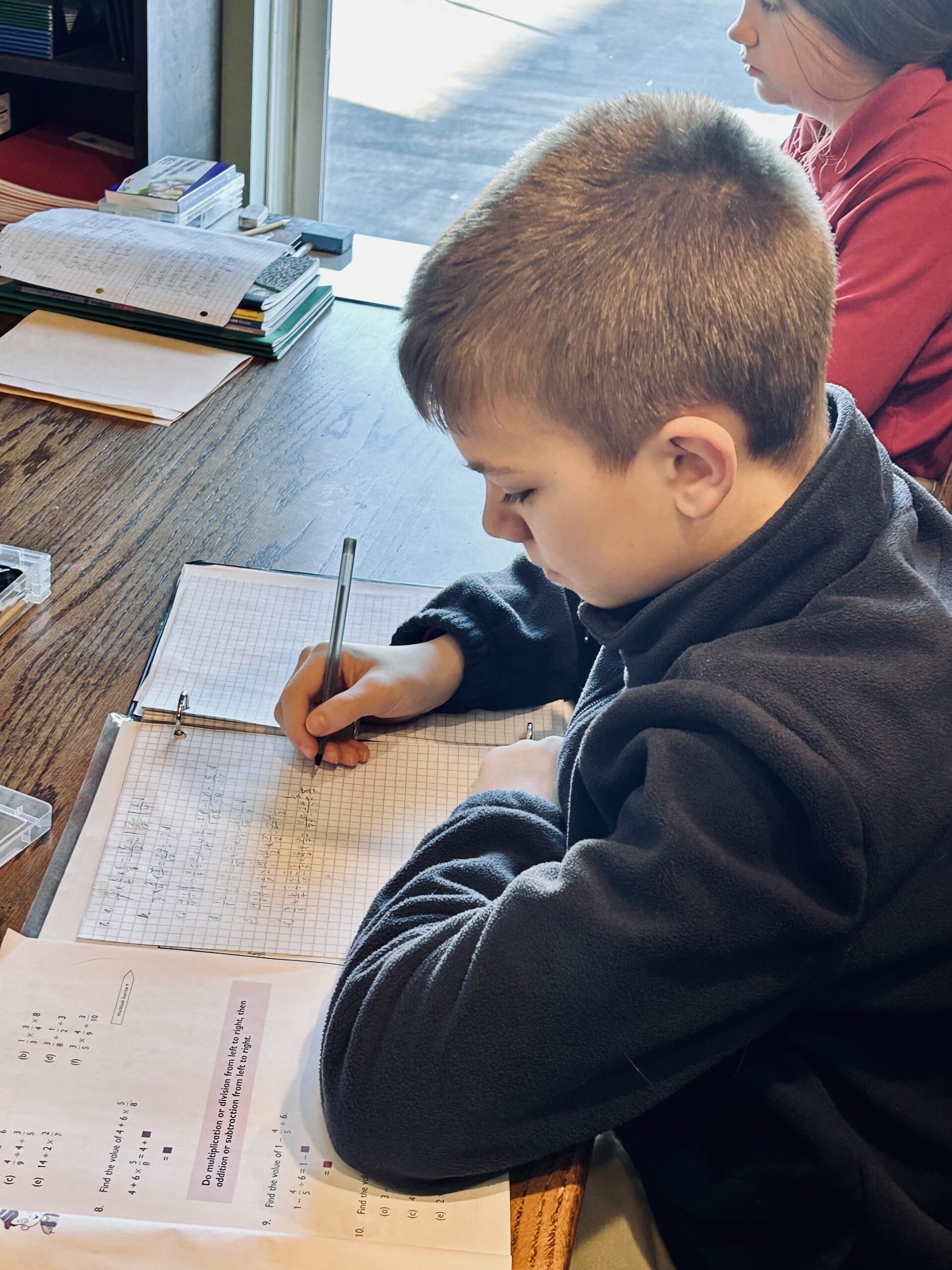
This approach prepared my children, informed them. Parents need to think of their children’s needs, and help the children think of others. If you set an expectation, you’re much more likely to have peace once you get there. That’s very different than the anxious, fussy, always-trying-to-get-my-way kind of battle we see too often between parents and children. I have seen this same approach beautifully demonstrated in Ambleside classrooms. A child would do something they ought not do, and the teacher would have such a gentle but clear way of correcting them, maybe just a touch on their shoulder or saying something quietly, but it was so gentle. And then the child would adjust and there was still a positive atmosphere in the classroom.
I would observe and think, “That’s how I need to do it at home. That should be my posture.” These teachers ask themselves: Does the child know what they ought to do? Are they weak to do as they ought (and then how can I support them)? Or is this really rebellion?
And even if it seems to be rebellion, perhaps later we can take one more step to wonder if something is going on with that child that we don’t understand, something that requires a few gentle questions. Often when my children were acting their worst, it was actually that they had been deeply hurt by me or others. If I dug deeper, I would find a pressing issue to be addressed, or a misunderstanding to be corrected. Most of the time when a child is treated as a person, they don’t act in rebellion. These questions and assumptions provide a much more peaceful atmosphere where children can learn and flourish.
The fruit of authoritative parenting is peace. First, the parent must commit to doing as they ought, rather than what they want. And this is the hardest part, because we are also weak. But when we parent from principle rather than convenience, when we act consistently rather than arbitrarily, and when we recognize our authority to be deputized by God for our children’s best long-term interest, we help them mature while keeping a healthy relationship with them. And the fruit of that growth is sweet, abundant, and enduring.
Kimberley Lorden
Co-Founder
Ambleside School of Colorado