Ambleside Schools International Articles

Browse more Ambleside Schools International Resources.
Character Formation 20 Years After the iPhone
Technology, AI, and Our Children
One thing AI hasn’t changed is the process of character formation and discipleship.
It has, however, diminished their occurrence in homes and schools. Human beings are creative, relational beings, created in the image of the God of the Universe. Our purpose is to know and love God and to love our neighbor – meaning we will find fulfillment in doing these things. Thus, proper use of any technology should contribute to human fulfillment, not detract from it.
The rapidly advancing pace of technological development presents an interesting and pressing challenge.
Even as we, as educators and parents, learn to navigate the never-ending cascade of “what’s next,” we also understand that how we interact with technology, including AI, carries significant consequences for the generation in our care.
We must accept that artificial intelligence will have a functional place in the daily lives of the current working generation and will likely play an even greater role for the next generation. However, understanding its negative consequences and positive influences is key to teaching our children how to think about it properly.
The downside of this tool is that it may create more opportunities for specific cognitive skills to remain underdeveloped. The people who don’t possess those cognitive skills will be less free and independent than they would have been otherwise. For this reason, among other ethical issues, AI usage in the home, school, and workplace must be guided by a strong set of rules based on a moral code.
Today’s technology has no neutral setting and should always be assumed to be overly invasive to family life. Therefore, parents should always start with an intentional plan to control and monitor what they allow into their homes.
Parents should first familiarize themselves with AI, research its power and potential for abuse, and establish family usage standards based on what would be good for humans – not just what is easy.
The plan should have rigid boundaries that everyone adheres to, and it should never rely on the presumed and hoped-for character of the family’s children. Hope is not a plan, and the burden of responsibility is too much for children, and most adults, for that matter, to bear.
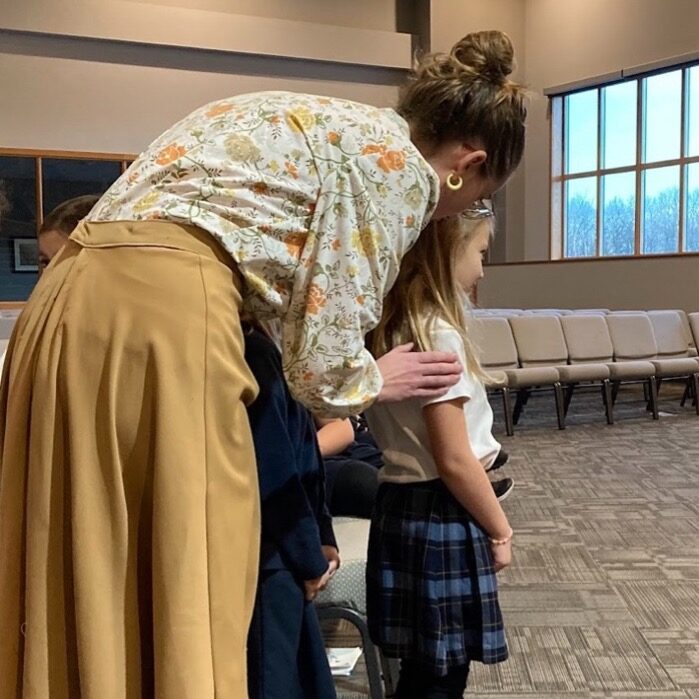
Humans need to have loving relationships with wise people who are willing to share their wisdom with us. Disciples need to read widely and develop skills that will better equip them to discern truth and beauty. Human-based educational models, where children spend their time with faithful adults and peers who love well and guide them to the truths of Christ, are needed now more than ever.
In a society such as ours, Christian education remains the greatest lever that the church has for “training a child in the way he should go,” which is why we must invest in these schools with our time, talent, and treasure.
How parents relate to AI will dictate much of what their children assume about its proper use.
As parents craft an intentional plan for each piece of technology in their home, they should include designated days, times, and locations for use. The plan should also incorporate 24-hour and weeklong breaks from technology. Preserve technology-free family times, such as meals, reading times, and family meetings.
To aid in this effort, choose to be a part of school, church, and social groups that share your thoughts on the proper place and use of technology. Your community will shape your child’s habits as much or more than your home will.
The proper use of any technology should contribute to human fulfillment, not detract from it.
The work of a student is to learn how to communicate what they have learned. Any reliance on AI to generate work meant to represent what one has come to know is not to be tolerated, for obvious reasons.
Alternatively, suppose the student used AI to gather more information (that can be verified as true) as part of the learning process to write more effectively when the time comes. In that case, the student is using AI in the same way I used an encyclopedia, thesaurus, or dictionary when I was in school.
In this way, the acceptable use of AI can be discerned by asking one simple question before using it: Am I using AI to do the work for me, or am I using AI to get what I need in order to do the work myself?
AI doesn’t need to be scary.
The consequences that AI holds, both good and bad, are speculative at this point, so the uncertainty surrounding all that comes with AI can cause a bit of anxiety.
It would be prudent for parents, teachers, and school leaders to remember that anxiety is one of the human emotions that can easily transfer to those around us. AI is largely a part of our children’s future, and if the future is doom and gloom, then we are not exactly sowing seeds of hope for the good that God’s children will be doing in the world of tomorrow.
Be careful with your words, take heart, and help your children navigate these uncharted waters.
For Further Reading
- The Book of Proverbs
- The Tech-Wise Family: Everyday Steps for Putting Technology in Its Place by Andy Crouch
- The Shallows: What the Internet is Doing to Our Brains by Nicholas Carr
- The Collapse of Parenting: How We Hurt Our Kids When We Treat Them Like Grown-ups by Leonard Sax
Russ York
Head of School
Ambleside School of Fredericksburg