Ambleside Schools International Articles
Browse more Ambleside Schools International Resources.
Independent Thinking Required: Charlotte Mason's Pedagogy and Ambleside Schools International
Self-directed thinking, personal responsibility, lively content, and the restrained role of the teacher characterize Charlotte Mason’s pedagogy. The network “Ambleside Schools International” supports schools in putting this approach into practice. Part one of two.
“The question is not – how much does the youth know? when he has finished his education – but how much does he care? and about how many orders of things does he care?” – This statement comes from British educational reformer and philosophy of education scholar Charlotte Mason (1842–1923). Only when one loves what one learns can learning lead to intellectual growth. According to Charlotte Mason, this is precisely what education consists of: the maturing of the person in heart and mind. But where is the pedagogical screw to turn so that children love what they learn? How can we ensure that what is learned takes on meaning, that horizons expand and intellectual growth occurs?
Wonder and Spiritual Growth
In wonder at creation, we simultaneously draw closer to our Creator. Therein lies a core principle of Christian education: it does not occur only in religious studies or Bible class, but should permeate all subjects and open our eyes to the traces of the Creator.
Charlotte Mason showed a path by which not only Christian homeschoolers, but also schools can create a learning environment in which intellectual growth is possible. She herself trained teachers in her “House of Education” in the English village of Ambleside according to her principles, and during her lifetime numerous schools in England worked according to her concept. Founded by the couple Maryellen and Bill St. Cyr, the network “Ambleside Schools International” has been supporting a growing number of schools for more than 25 years in translating Mason’s pedagogy into practice. Through teacher training, coaching, and regular exchange, approximately 30 member schools are guided in implementing the concept.
Ambleside schools stand out without performance pressure through remarkably good results. The guiding motto of Ambleside Schools International is “Excellence in Humility.” The goal is not to be the best, but to turn toward the best: the True, the Good, and the Beautiful.
The Three Means of Education
Mason understands the child as a person who cannot be shaped like wax from the outside, but must grow like a living organism from within. Therefore, she repeatedly emphasizes: “All education is self-education.” At the same time, the child, due to his weakness and ignorance, is dependent on the help and care of others. For this purpose, Mason identifies three “means of education” that do not act directly on the child, but bring about his inner growth in an indirect way: “the atmosphere of the surroundings, the discipline of habit, and the presentation of living ideas.”
It is therefore about offering living ideas rather than mere facts: through good books, nature, art, music, and direct encounter with things themselves. Each school day should, according to Mason, be like an intellectual feast that offers nourishment for children’s minds.
In the didactic triangle, Mason places not the child, nor the teacher, but the content at the center: As long as the content is “living” – that is, not pre-digested, diluted, or reduced to mere facts – Mason is convinced that a living encounter occurs between the child and the content. The teacher must give this encounter space, prepare it, accompany it, and deepen it. She must greatly restrain her role as mediator. Charlotte Mason calls this attitude “Masterful Inactivity.”
However, this restraint on the teacher’s part does not apply equally to all subjects. At Ambleside schools, a distinction is made between two types of subjects: the “Inspirationals” – subjects such as literature, Bible, natural history, poetry, music appreciation, or art observation, in which a text, a natural object, a musical piece, or a work of art is the actual source of knowledge – and the “Disciplinaries,” that is, skill-oriented subjects such as writing, arithmetic, grammar, or foreign languages.
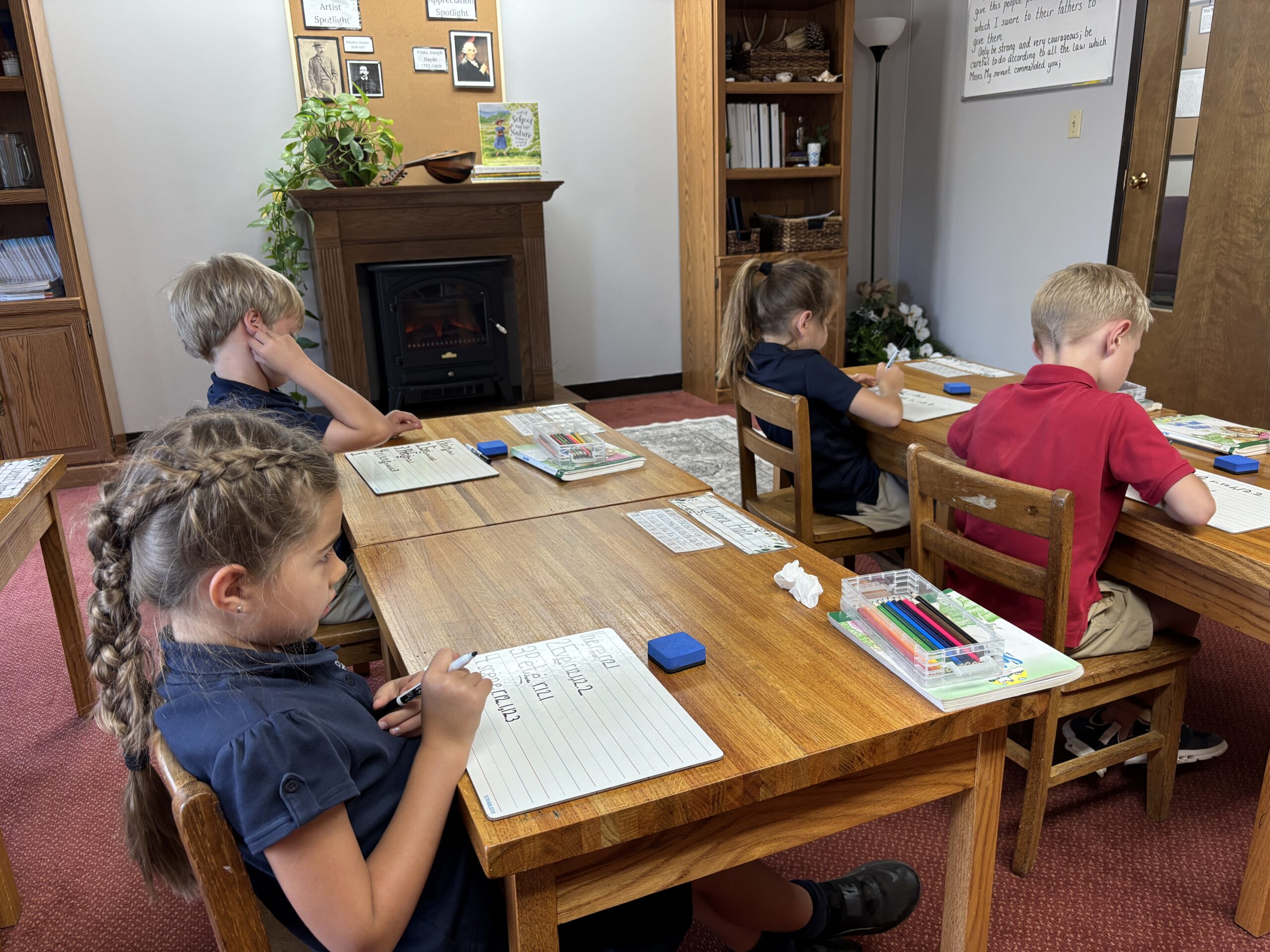
With the latter, the teacher appears much more prominently: she conducts instruction tightly and vibrantly and ensures that all students, even the weaker ones, are in constant interaction. An example: Each student writes his answer on a mini-whiteboard and holds it up. The teacher can see at a glance whether all students have grasped the content and can give immediate feedback, for example by nodding. Unlike the “Inspirationals,” answers can be clearly judged as right or wrong. When there are errors, the teacher asks follow-up questions or corrects. Her role is overall more active, but she should not take up more than half the speaking time and should step back wherever students can take the next step themselves, such as by justifying a solution, making a correction, or formulating a rule.
Creating Space for Thinking
How “Masterful Inactivity” manifests itself concretely can best be illustrated by the course of a typical lesson. In a brief introduction phase, the teacher prepares her students for the text: she has the content of the previous lesson briefly reviewed, clarifies difficult concepts, shows connections to the context, but does not yet reveal the content. In the second section, the students read the text together. When a narrative arc is complete, the teacher stops the reading and has a child retell it, for example by saying: “Jesus got into a boat with his disciples. Sarah, what happens next?” The retelling proceeds section by section in plenary or partner work: “Window side, tell your partner what happened next!” and after an appropriate time: “Door side, add what is still missing.” Retelling in correct sequence and in the author’s language requires a high degree of intellectual activity. Someone who, for example, only fills in a gap text or searches a text for specific information gets by with significantly less thinking. With retelling, however, the text is internalized – it becomes the student’s own.
Now the student is ready for the phase of deepening through discussion: The teacher asks open questions that stimulate thinking. Here the attitude of “Masterful Inactivity” is particularly called for, because a question is only truly open if it does not expect a particular answer. For example, to the question “Why is Jesus sleeping in the boat?” students will probably express quite different thoughts. Some answers may particularly move or surprise the teacher. Nevertheless, she does not praise and does not single out individual contributions above others, but receives each answer with equal appreciation. Otherwise, she would make herself the judge of the children’s answers. The students would then – as so often in school – be occupied with figuring out which answer the teacher wants to hear (“fishing”). Some children play this game successfully, but many others give up and stop seriously engaging with the topic.
The teacher also does not end the discussion with her own interpretation. Otherwise it would mean for the students: “Aha, so that’s the solution; I can have it without thinking.” Often it is better if a question remains unsolved and continues to work in the children’s minds. The episode from the life of Jesus is not closed off; rather, it is only just beginning. A relationship can begin to form.
In principle, for “Inspirationals”: The more the teacher talks, the less the students will think. Therefore, after the introduction phase, Ambleside teachers use declarative sentences as little as possible. They give only work instructions or ask questions, so that as much active thinking work as possible remains with the students. For just as food intake is an active process, so is learning. A richly set table nourishes no one if one does not help oneself. Similarly, content can only educate if it is internalized and processed: students must read, think, and make the ideas their own. For educators, the required restraint is usually both challenging and liberating: challenging, because the teacher must forego anticipating and directing the children’s thoughts through her own explanations. Liberating, because she is not herself the source of knowledge, but can trust that the intellectual nourishment offered does its work in the child.
Further Information
The international network “Ambleside Schools International” offers seminars and training courses in which interested teachers can learn about and deepen their understanding of Mason’s pedagogical concept. Further information can be found at www.amblesideschools.org.
Jutta Graf
Jutta directs the Catholic private school “Die Lerche” in Linz and is a member of Ambleside Schools International. The article was published in German by “Die Deutsche Tagespost” on August 6th 2026.